CryptoSecure: AI-Powered Smart Contract Security
On this page
- Question
- Can a developer check a TON smart contract before it ships?
- Method
- Static analysis paired with a language model. Team of 4, about 3 months.
- What we found
- An AI security tool that pairs static analysis with a language model so developers on the TON network can check smart contracts before they ship.
- What changed
- Developers can run that check before a contract ships.
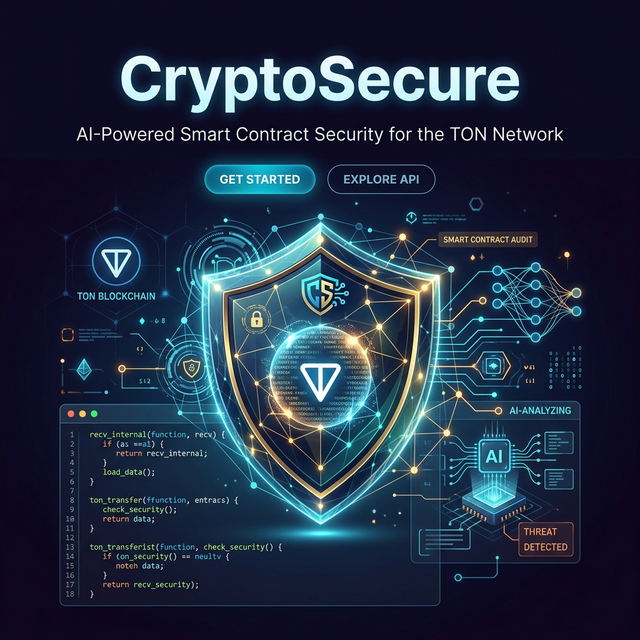
Making Blockchain Security Accessible to Every Developer on the TON Network
Skill Constellation
Primary
Supporting
Emerging
Project Type: Graduate Team Project — Drexel University
Duration: ~3 months
The Problem Nobody Was Solving
Here's a number that should worry anyone building on the TON blockchain: 14,995 vulnerabilities were recently discovered across just 1,640 smart contracts. That's more than 9 bugs per contract on average. And these aren't cosmetic bugs — they're security holes that let hackers drain wallets, steal funds, and exploit users.
The TON blockchain is exploding. Telegram's 900+ million users are being funnelled into a crypto ecosystem that's growing faster than the security infrastructure can keep up. Developers — many of them building their first smart contracts — are deploying code that handles real money. And the safety net doesn't exist.
A professional security audit costs $10,000 to $50,000 and takes 2 to 4 weeks. Impossible for independent developers, students, or small NFT teams.
Existing tools catch syntax errors—like spell-checking a legal document. They miss semantic vulnerabilities and logic flaws that get exploited.
So developers are left with a choice: spend money they don't have on a manual audit, or launch and hope for the best. We built CryptoSecure to eliminate that choice.
Smart contract vulnerabilities aren't just technical bugs. They're real money at risk. A reentrancy flaw in a DeFi contract doesn't just cause an error — it lets someone drain the entire liquidity pool. The stakes aren't theoretical.
Problem Framing
Identified underserved market gap: individual and student developers on TON who need audit-grade security but can't afford $10K+ audits.
Evidence: 14,995 vulnerabilities across 1,640 contracts; no free TON-native tool existed.
What We Built
CryptoSecure (also called TON Guardian) is an AI-powered security scanner that analyses TON smart contracts in seconds, identifies vulnerabilities across 8+ categories, explains them in plain English, and generates the actual code fixes — not just warnings, but working patches.
The experience is designed for developer velocity, not security theatre:
Upload → Analyse → Fix → Export. That's it.
A developer drags in their FunC or Tact smart contract file (or pastes a code snippet directly). The AI engine scans it in under 30 seconds. A security score from 0 to 100 appears, with vulnerabilities broken down by severity — Critical, High, Medium, Low. Each finding comes with a plain-language explanation of what's wrong, what could happen if it's exploited, the specific lines of code affected, and a recommended fix with working replacement code.
The developer reviews the fixes in an interactive diff viewer — side-by-side comparison, colour-coded changes, the ability to accept, reject, or manually edit each suggestion. When they're satisfied, they export a professional PDF audit report with severity scoring, impact analysis, and an executive summary suitable for sharing with investors or partners.
What used to cost $10,000 and take a month now takes 30 seconds and costs nothing.
Owning the Engine & Interface
In a team of four, I owned two areas: the AI/ML analysis pipeline and portions of the frontend interface.
The AI Engine
The core technical challenge was this: how do you get an AI system to understand smart contract security deeply enough to catch real vulnerabilities — not just pattern-match against a list of known bad code snippets? The approach combined two layers:
Layer 1: Static Analysis & Heuristic Engine
A custom vulnerability database built from TONScanner research and known exploit patterns specific to the TON blockchain. This catches the deterministic issues—the patterns we know are dangerous based on historical exploits and documented vulnerability classes. This layer works without any API dependency and provides baseline detection.
Layer 2: AI-Powered Semantic Analysis
Using OpenAI's GPT-4o model to perform deeper semantic reasoning about the contract's logic. This is where CryptoSecure goes beyond what traditional automated tools can do—the AI can understand the intent of the code, spot logical flaws that aren't captured by pattern matching, and reason about how different functions interact in ways that create emergent vulnerabilities.
The combination matters. Static analysis is fast and deterministic but limited to known patterns. AI semantic analysis can catch novel vulnerabilities but can hallucinate or miss deterministic issues. Together, they're more reliable than either alone.
Dual-Layer Analysis Architecture
Combined deterministic static analysis with GPT-4o semantic reasoning. Neither alone is sufficient — together they catch both known patterns and novel logic flaws.
Evidence: 8+ vulnerability categories detected; handles both deterministic and emergent issues.
The vulnerability categories the engine detects:
| Category | What It Catches | Why It Matters on TON |
|---|---|---|
| Reentrancy | Functions called recursively before state updates complete | The #1 exploit vector in DeFi — the classic "drain" attack |
| Access Control | Missing permission checks on privileged functions | Allows unauthorised users to execute admin operations |
| Integer Overflow | Arithmetic operations that exceed data type bounds | Can manipulate balances, mint tokens, or bypass limits |
| Unchecked Returns | External calls whose return values aren't validated | Failed operations that proceed as if they succeeded |
| Gas Limit Issues | Operations that could exceed gas limits mid-execution | Transactions that revert after partial state changes |
| TON Defects | Vulnerabilities unique to FunC/Tact and TON | Issues not caught by tools designed for Ethereum/Solidity |
| Input Validation | Missing or insufficient validation of external inputs | Allows attackers to pass malicious data |
| Logic Errors | Semantic flaws in business logic | Requires understanding what the code is supposed to do |
The "Hacker Mode" Feature
We built an advanced analysis mode (powered by GPT-4o with a dedicated API key) that goes beyond detection into adversarial thinking. Hacker Mode doesn't just identify vulnerabilities — it describes how an attacker would exploit them, step by step. This was designed for developers who want to understand the threat model, not just the fix list.
Think of it as the difference between a doctor saying "you have high blood pressure" and a doctor explaining "here's what will happen to your cardiovascular system over the next 10 years if this isn't addressed." The second version creates urgency and understanding. Hacker Mode does the same for smart contract security.
Adversarial Thinking (Hacker Mode)
Designed prompt engineering to generate step-by-step exploit narratives, transforming abstract vulnerability reports into concrete threat models.
Evidence: Developers understand WHY a flaw is dangerous, not just that it exists.
Frontend Contributions
I worked on portions of the React frontend, specifically around the security score visualisation (built with Recharts), the vulnerability report display, and the integration between the analysis engine output and the UI components. The interface uses Shadcn UI components styled with Tailwind CSS, with a dark-mode aesthetic that matches the developer tooling context.
The Design Decisions That Mattered
Decision 1: Plain English Over Error Codes
Most security tools speak in jargon: "CVE-2024-XXXX detected at line 47." Technically accurate. Practically useless to a developer who isn't a security specialist. We made a deliberate choice: every finding would be explained in language a developer with no security background could understand. Not dumbed down — just translated.
Decision 2: Fix It, Don't Just Flag It
Identifying a vulnerability is only half the value. Every finding includes a remediation section with working replacement code. The interactive diff viewer shows the vulnerable code on the left and the patched code on the right. This transforms the tool from a diagnostic into a solution.
Decision 3: The Security Score as a Trust Signal
The 0–100 security score isn't just a vanity metric. It's designed to be shareable — a signal that a project can show to investors, partners, and users to demonstrate that their contract has been analysed and meets a minimum security threshold.
Decision 4: Sample Contracts for Education
We included pre-loaded vulnerable contracts so developers can see the tool in action immediately. This serves two purposes: it removes the "cold start" barrier, and it educates developers about common vulnerability patterns before they encounter them in their own work.
Developer-Centric UX
Every design decision served developer velocity: plain English explanations, working code fixes, interactive diff viewer, and shareable security scores.
Evidence: Four distinct design principles each grounded in developer workflow research.
The best security tool is one that makes developers better at security — not just one that catches their mistakes. If a developer uses CryptoSecure ten times and starts writing more secure code on the eleventh, that's a bigger win than catching ten bugs.
Technical Architecture
Competitive Positioning
We built CryptoSecure to fill a specific gap that no existing tool addresses:
| Capability | CryptoSecure | Manual Audits | Existing Tools |
|---|---|---|---|
| Speed | 30 seconds | 2–4 weeks | Minutes |
| Cost | Free | $10k–$50k | Free–$1k |
| Explanation | Plain English with fixes | Technical reports | Error codes |
| Understanding | AI-powered reasoning | Human expertise | Pattern match |
| Accessibility | Any developer | Enterprise only | Sec-minded |
| TON support | Built for FunC/Tact | Varies | Almost none |
| Fix gen | Automatic patched code | Manual advice | None |
| Learning | Adapts to new exploits | Manual updates | Fixed rules |
What We Compressed
The value proposition is a compression ratio: $10,000–$50,000 and 2–4 weeks of manual audit → 30 seconds and $0. That's not a marginal improvement. It's a category shift in who can afford to write secure smart contracts.
Under 30 seconds to scan a smart contract natively.
Detects various categories including TON-specific defects.
Production deployments on Vercel ensuring continuous availability.
Provides working patched code for detected issues.
Why it matters at scale: TON aims to onboard 500 million users by 2027. That growth will be built on smart contracts written by thousands of developers — most of whom won't have security budgets. CryptoSecure makes the difference between those contracts being audited or being deployed blind.
Reflections & Next Steps
AI is a tool, not an oracle. The most important design decision we made was layering static analysis under the AI engine rather than relying on AI alone. GPT-4o is remarkably good at semantic reasoning about code — but it can hallucinate or produce overconfident assessments. Together, they're genuinely useful.
Explanation is a feature, not a nice-to-have. A security tool that says "reentrancy vulnerability detected" is technically correct but practically useless to 80% of its target audience. Making security knowledge accessible isn't a UX polish item — it's the core value proposition.
Developer experience drives adoption for developer tools. The diff viewer, the auto-fix engine, the one-click export — these aren't the "smart" parts of the tool. But they're why developers actually use it rather than looking at the vulnerability list and closing the tab.
My UX instincts shaped the ML output design. Eight years of thinking about how users consume information directly influenced how the analysis engine presents its findings. The severity hierarchy, the progressive disclosure, the visual score dashboard — these are UX patterns applied to ML output.
UX-Shaped ML Output
Applied 8 years of UX thinking to ML interface design: severity hierarchy, progressive disclosure, and visual scoring transformed raw analysis into actionable developer experience.
Evidence: Severity hierarchy, diff viewer, and score dashboard — all UX patterns applied to ML.